


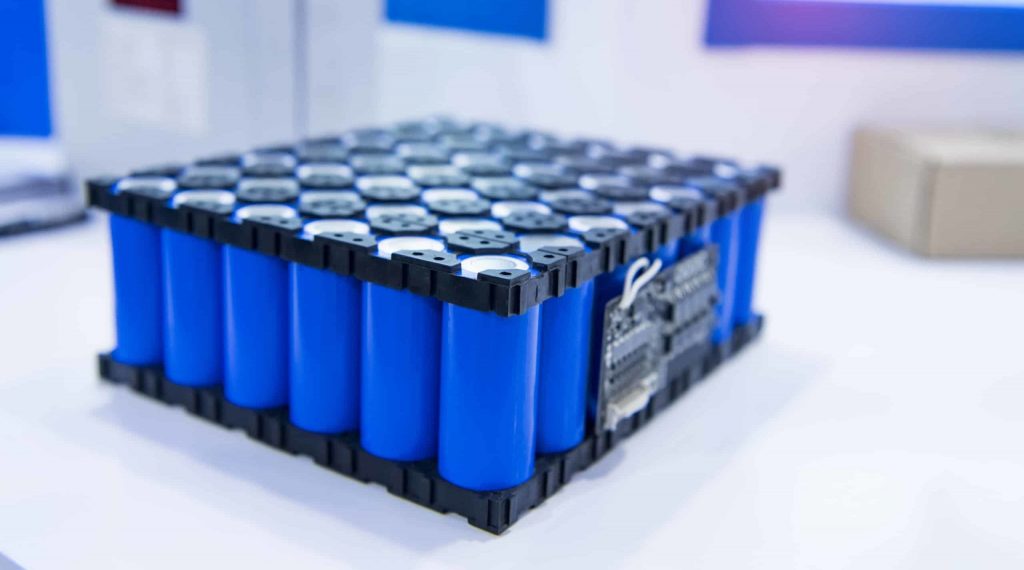
A Complex Process Requiring High Precision
Lithium batteries are rechargeable batteries that use lithium as the active material in the anode and cathode. They have become the dominant battery technology for a wide range of applications, including smartphones, laptops, electric vehicles, and energy storage systems.
The manufacturing of a lithium battery is a complex process that requires high precision. It takes place in several steps, which we will examine in more detail below.

1. Extraction of Raw Materials
The first step in manufacturing a lithium battery is the extraction of the necessary raw materials. Lithium is a relatively rare metal, mainly extracted from two sources:
- Pegmatite mines, which are lithium-rich igneous rocks.
- Saltwater sources, which contain high concentrations of lithium.
Once extracted, lithium is processed into lithium carbonate, which is the form used for battery manufacturing.
2. Production of Active Materials
Active materials are the essential components of a lithium battery. They are responsible for converting chemical energy into electrical energy.
The anode of a lithium battery is typically made of graphite, a conductive material. The cathode can be composed of various metal combinations, including cobalt, nickel, manganese, and lithium.
The production of active materials occurs in several steps, which include:
- Manufacturing the negative electrode: graphite is usually treated at high temperature to produce a porous material that allows electrolyte circulation.
- Manufacturing the positive electrode: metals used for the cathode are mixed with other substances, such as salts, to form an active material.
3. Cell Manufacturing
A lithium battery cell consists of an anode, a cathode, an electrolyte, and a separator.
The electrolyte is a liquid or gel that allows lithium ions to move between the anode and cathode. The separator is a membrane that prevents the two electrodes from touching directly.
Cell manufacturing occurs in several steps, which include:
- Placement of active materials: the anode and cathode are placed in aluminum or steel casings.
- Addition of the electrolyte: the electrolyte is added to the cell under vacuum to avoid air bubbles.
- Insertion of the separator: the separator is placed between the anode and cathode.
- Sealing the cell: the cell is closed with an aluminum or steel cap.
4. Battery Assembly
A battery consists of multiple cells connected in series or parallel. The series configuration increases battery voltage, while the parallel configuration increases capacity.
Battery assembly occurs in several steps, which include:
- Welding the cells: the cells are welded together to form a battery.
- Adding the Battery Management System (BMS): the BMS is an electronic circuit that monitors the battery and protects it against overcharging, deep discharge, and short circuits.
- Packaging the battery: the battery is enclosed in a casing to protect it from shocks and vibrations.
5. Testing
Batteries undergo a series of tests to ensure quality and performance. These tests include:
- Cycle tests: batteries are charged and discharged multiple times to evaluate durability.
- Temperature tests: batteries are tested at high and low temperatures to assess performance under extreme conditions.
- Safety tests: batteries are tested for resistance to overcharge, deep discharge, and short circuits.
Conclusion
Lithium battery manufacturing is a complex process that requires high precision. It occurs in several stages, including raw material extraction, active material production, cell manufacturing, battery assembly, and testing.
Technological advances in lithium battery manufacturing have significantly improved their performance and lifespan.