


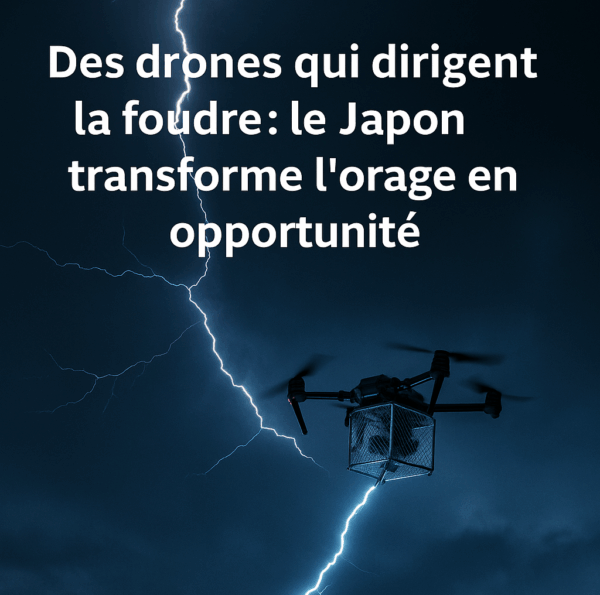
What once belonged to science fiction is becoming reality: in Japan, drones are no longer used only to film… but to control lightning.
When the sky becomes a resource to harness
Imagine that instead of enduring thunderstorms, we could guide them. This is precisely what researchers at Nippon Telegraph and Telephone (NTT) are achieving. In December 2024, during tests conducted in the Toyama region, drones equipped with Faraday cages deliberately attracted lightning strikes mid-flight, without being destroyed.
This achievement is far from a magic trick. It relies on well-known electromagnetic principles, but never implemented in such a precise and controlled way. The result: intentional redirection of electrical discharges into secure and isolated areas.
From protection to energy recovery
Initially designed to protect sensitive infrastructure (airports, data centers, industrial sites), this technology could go further. NTT is already mentioning the possibility of capturing lightning energy — an ambitious goal, but not entirely unrealistic.
A single lightning strike can release up to 5 billion joules, equivalent to a household’s electricity consumption for a month. If even a fraction of that energy could be recovered and stored, lightning could become a supplementary renewable energy source, fully aligned with a decarbonized vision of energy.
Behind the technological feat, a leap in risk management
The tested drones are equipped with measurement systems, high-voltage sensors, and innovative shielding. Everything is controlled by onboard AI capable of calculating probable discharge trajectories in real time and adjusting the drone’s position with millimeter precision.
It is therefore as much a matter of precision mechatronics as of advanced management of critical phenomena. A sector where power electronics, embedded algorithms, and smart materials converge to push boundaries.
And now? Toward a paradigm shift
Lightning is one of the last natural phenomena humans do not control. This NTT project, far from being a gadget, opens a new chapter in our relationship with extreme weather. In a context of climate disruption, where violent events are increasing, the ability to anticipate — or even channel — them is no longer a luxury, but a necessity.
At CoOptek, we closely monitor this type of breakthrough innovation. Not to replicate it, but to draw inspiration from it: designing robust embedded systems capable of withstanding hostile environments is already what we do — from batteries to enclosures, from BMS to full integration. Technological rigor is part of our daily work.
An idea, a project, an extreme constraint to solve? Let’s talk.