


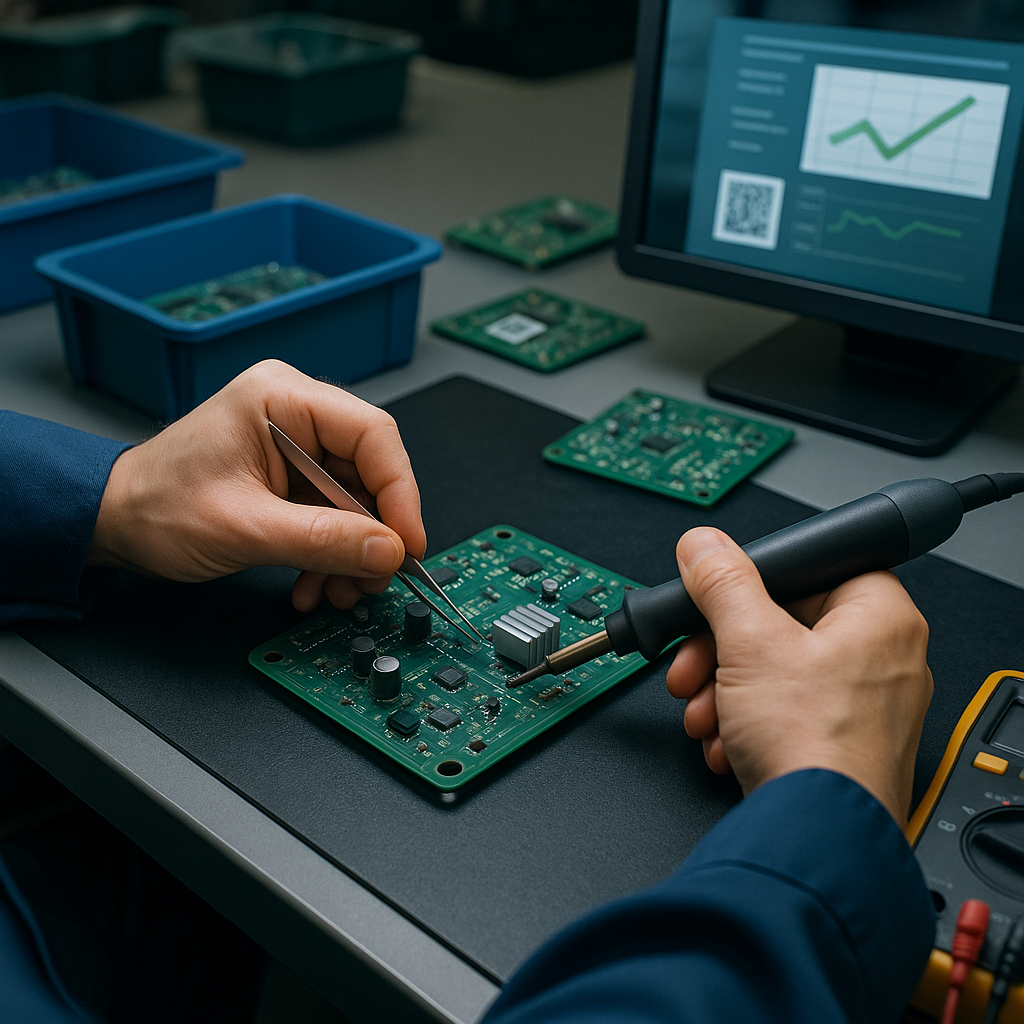
💡 What if the future of electronics was no longer about producing more, but about producing better?
Electronic manufacturing has long relied on a linear model: design, produce, use, discard.
Today, this model is reaching its limits. Component shortages, rising material costs, environmental pressure, and the pursuit of industrial autonomy are driving a new approach: refurbishment.
Refurbishment, or remanufacturing, involves restoring an existing electronic product to like-new condition, giving it a second life — with the same reliability, the same performance, and often… a significantly lower environmental impact.
🔄 Industrial refurbishment: far more than a passing trend
Some refer to “Remade in France” as a slogan. At CoOptek, we see it primarily as industrial logic.
Refurbishing a product is not patching up a repair: it means rebuilding a product to like-new condition through a standardized, traceable, and controlled process.
The key stages are clear:
-
Collection and sorting of end-of-use products.
-
Technical diagnostics: identification of failures, electrical and functional testing.
-
Selective replacement of defective, obsolete, or visibly damaged components.
-
Cleaning, firmware reprogramming, recalibration.
-
Full requalification, in accordance with ISO 9001 quality standards and customer requirements.
Each refurbished product therefore goes back through a complete industrial circuit, often on the same test benches and assembly lines as new products.
🌍 A triple benefit: environmental, economic, and strategic
Reducing environmental impact
A refurbished electronic product can represent up to –70% lower carbon footprint compared to a new product.
Why? Because components, rare metals, and base boards are reused.
Every board saved, every housing reused, preserves valuable resources.
Protecting cash flow and the supply chain
Producing a new product means tying up cash, ordering components, and relying on global logistics.
Refurbishment makes the supply chain more agile.
Companies that integrate refurbishment gain better cost control, reduce lead times, and secure production against shortages.
Enhancing brand value and customer relationships
A refurbished product is also a demonstration of responsible commitment.
End users — both individuals and professionals — are seeking repairable, durable, and traceable products.
Offering a “Refurbished” range helps extend customer relationships, strengthen loyalty, and project a technological, responsible, and consistent brand image.
🛠️ CoOptek expertise: from production to re-manufacturing
At CoOptek, the refurbishment approach is built on proven expertise in wiring, assembly, testing, and industrialization.
Our sites, located in France, Portugal, and Tunisia, have all the necessary capabilities to:
-
Disassemble and diagnose complex electronic assemblies.
-
Repair, replace, and reprogram boards, modules, and subassemblies.
-
Test each product according to its original validation criteria.
-
Repackage and trace refurbished products, with a unique serial number or QR code.
This approach ensures seamless integration of refurbishment into the industrial chain, without disruption between new production and re-manufacturing.
🔬 Eco-design: integrating refurbishment from the product design stage
Successful refurbishment begins well before the product’s end of life.
The key lies in eco-design:
-
making products easy to disassemble,
-
facilitating replacement of critical components,
-
planning for electronic traceability via firmware or digital labeling,
-
documenting testing and calibration processes.
This anticipation enables a simple, fast, and profitable refurbishment loop later on.
Design offices that create products with a second life in mind develop truly sustainable products — technically, economically, and environmentally.
⚙️ Diverse and adaptable business models
Refurbishment is not limited to resale.
It can be integrated into several possible strategies:
-
“Certified Refurbished” resale through existing channels.
-
Standard exchange as part of a maintenance contract.
-
Rental fleet where products are refurbished between cycles.
-
Charitable donation to give value to refurbished products that cannot be commercialized.
Each company defines its own circular loop according to its volumes, use cases, and end customers.
CoOptek supports this implementation in a pragmatic and industrial manner.
🚀 Toward a more circular and smarter industry
Today, refurbishment is both an industrial innovation lever and an environmental necessity.
It transforms end-of-life into a new economic opportunity, restores meaning to local production, and contributes to European technological autonomy.
Electronics are not meant to be disposable.
They are meant to be evolving, maintainable, and sustainable — reflecting the industry we are building at CoOptek: demanding, responsible, and forward-looking.