


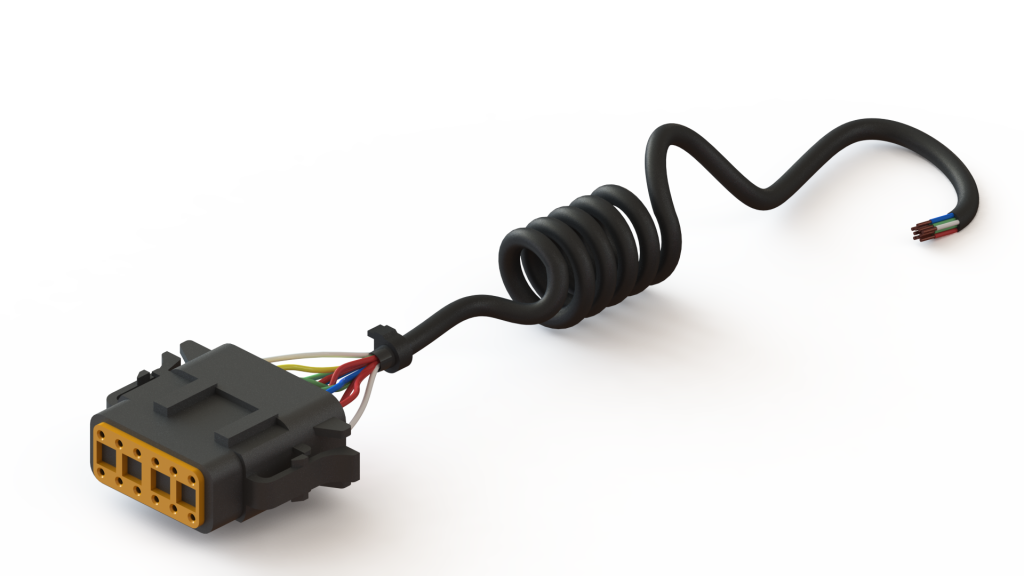
In the electronics industry and connected equipment sector, wiring remains a critical point. A custom wiring harness or cable assembly is not just “assembled wires”; it is a mechanical and electrical subsystem that directly impacts reliability, safety, maintenance, and production repeatability.
But on the manufacturer side, the same dilemma constantly arises:
- How can you prototype quickly (and properly) to validate a product fast?
- How can you industrialize afterward without exploding costs or degrading quality?
- How can you absorb variable volumes with sometimes tight lead times?
At CoOptek, we have built a pragmatic and high-performance approach: a hybrid model, combining local prototyping and multi-site mass production.
The objective: to offer our clients the best of both worlds.
Why local prototyping is essential (even in 2026)
A harness prototype is not only meant to “make the system work.” It is used to:
- validate the electrical architecture (pinout, continuity, shielding, etc.),
- confirm mechanical sizing (lengths, routing, fastening),
- test resistance to real-world constraints (bending, vibration, pull force),
- anticipate integration issues: cable glands, ducts, enclosures, assembly constraints,
- quickly correct the design before “freezing” mass production.
The challenge is that a prototype often involves:
- drawing revisions,
- BOM modifications,
- connector changes,
- bench testing,
- fixture rework.
➡️ If the prototype is too far away (geographically or culturally), iterations become slow, costly, and imprecise.
This is why CoOptek prioritizes local prototyping: faster, more interactive, and more reliable.
The classic problem: prototype here, mass production elsewhere = quality gap
Many companies operate this way:
- Prototype produced locally (or in-house)
- Mass production directly outsourced “offshore” or to another workshop
- Result: the series “looks like” the prototype… but is not identical
Then issues arise:
- less tidy harnesses,
- approximate lengths,
- poor stripping/crimping practices,
- inconsistent marking,
- unvalidated alternative components,
- production drift over time.
➡️ The real risk is not cost.
➡️ The real risk is lack of repeatability.
At CoOptek, our hybrid model was specifically designed to prevent this.
The CoOptek hybrid model: local to control, multi-site to scale
Our approach is based on a simple idea:
✅ Everything that must be learned, understood, validated, and frozen is done locally.
✅ Everything that must be repeated and industrialized is done at the most suitable site, under control.
In practice, our process follows two major phases.
Phase 1: Local prototyping (fast, iterative, documented)
Local prototyping enables close coordination with engineering and product teams.
1) Technical validation
We validate critical points:
- schematics and pinouts,
- EMC constraints if shielding is required,
- cable cross-sections (AWG / mm²),
- sleeve selection (braided, heat-shrink, PVC, etc.),
- mechanical routing.
2) Industrial fine-tuning
A prototype is not just a “sample.”
At CoOptek, we prototype as if we were about to industrialize, preparing from the start:
- the bill of materials (BOM),
- the harness drawing,
- the operations list (routing sheet),
- inspection rules,
- quality checkpoints.
3) Preparing for serial transfer
A successful prototype must become a “standard,” with:
- a clear reference,
- stable identification marking,
- controlled lengths,
- frozen component codes,
- a defined (and measurable) finish level.
➡️ At the end of prototyping, we do not just deliver a harness:
we deliver a harness + an industrialization-ready technical file.
Phase 2: Multi-site mass production (adapted to volume, budget, and lead time)
Once the product is stabilized, the objective shifts:
- from “iterative custom work” to “controlled repeatability,”
- absorbing volumes,
- meeting deadlines,
- securing the supply chain.
This is where our multi-site organization makes full sense.
How do we choose the right production site?
Depending on the project, we direct production based on:
- monthly volume,
- harness complexity,
- required finish level,
- component/connector availability,
- lead-time constraints,
- target budget.
This may include partner sites in Europe or Asia, under a CoOptek quality framework.
Tangible benefits of the hybrid model for our clients
1) Reduced lead time in critical phases
The prototype is often the critical path of a product project.
With local prototyping:
- shorter iteration cycles,
- immediate corrections,
- clearer communication.
➡️ Ultimately, the product is industrialized faster.
2) Controlled mass production thanks to an “industrial-ready” prototype
The hybrid model is not “prototype here / production elsewhere.”
It is:
- a “reference” prototype
- industrialization guided by that prototype
➡️ The prototype-to-production gap is drastically reduced.
3) Optimized costs without compromising quality
Local prototyping is not the cheapest option per unit.
But it is often:
- the most cost-effective globally,
- the option that avoids expensive re-iterations,
- the one that reduces field returns.
4) Industrial flexibility
Multi-site production allows:
- absorbing production peaks,
- securing supply,
- managing multiple customer programs in parallel.
Key factors for a hybrid model to truly work (not just on paper)
A hybrid model only works if the transfer is controlled.
At CoOptek, we focus on four pillars.
1) A robust technical file
It must include:
- harness drawing,
- validated BOM,
- photos of the reference prototype,
- stripping, crimping, and sleeving rules,
- marking requirements,
- end-of-line tests.
2) Consistent quality rules
The same standards must apply:
- visual inspection,
- dimensional checks,
- electrical testing,
- traceability.
3) Active project management
Serial transfer is not “sending an email.”
It means:
- supporting production launch,
- locking the first batch,
- validating initial samples,
- monitoring production drift.
4) Continuous improvement mindset
Good industrialization should enable:
- assembly time reduction,
- length optimization,
- component standardization,
- improved maintainability.
Which types of clients/projects benefit most from this model?
The CoOptek hybrid model is particularly suited for:
- IoT products / embedded electronics,
- industrial instrumentation,
- field sensors,
- special-purpose machines,
- systems with vibration/temperature constraints,
- prototypes that must quickly transition to mass production,
- projects with fluctuating demand (small batches followed by ramp-up).
Conclusion: a simple yet highly effective model
Local prototyping provides:
- speed,
- technical control,
- quality.
Multi-site production provides:
- capacity,
- cost optimization,
- flexibility.
➡️ Together, they create a robust model: industrialize fast, produce well, adapt sustainably.
At CoOptek, this is our daily reality: fast and clean prototypes, followed by controlled mass production ramp-up, driven by a coherent process and quality logic.
Do you have a custom harness, cable assembly, or wiring project?
We support:
- Design
- Prototyping
- Industrialization
- Mass production